How to Stop Losing Leads with Automated Follow-Up (And Reclaim 20 Hours a Week)
How to Stop Losing Leads with Automated Follow-Up (And Reclaim 20 Hours a Week)
You had a great discovery call. You sent the proposal. You followed up once. They didn't respond. So you told yourself they must not be interested — and you moved on.
Here's what actually happened: they went with someone else who showed up five more times than you did.
If you want to stop losing leads with automated follow-up, you're in the right place. Because the fix isn't working harder — it's building a system that works when you don't.
Why You're Losing Leads (And It's Not Your Offer)
Let's clear something up right away. Most service-based business owners don't have a lead generation problem. They have a follow-up problem.
Studies show that almost 50% of local business leads never receive a follow-up after the first attempt — not a second call, not a text, not even an email. And the reason isn't laziness. It's capacity. You're running an entire business. You cannot hold every lead in your head and manually nurture them through your pipeline on top of everything else you're doing.
But here's what that costs you in real numbers:
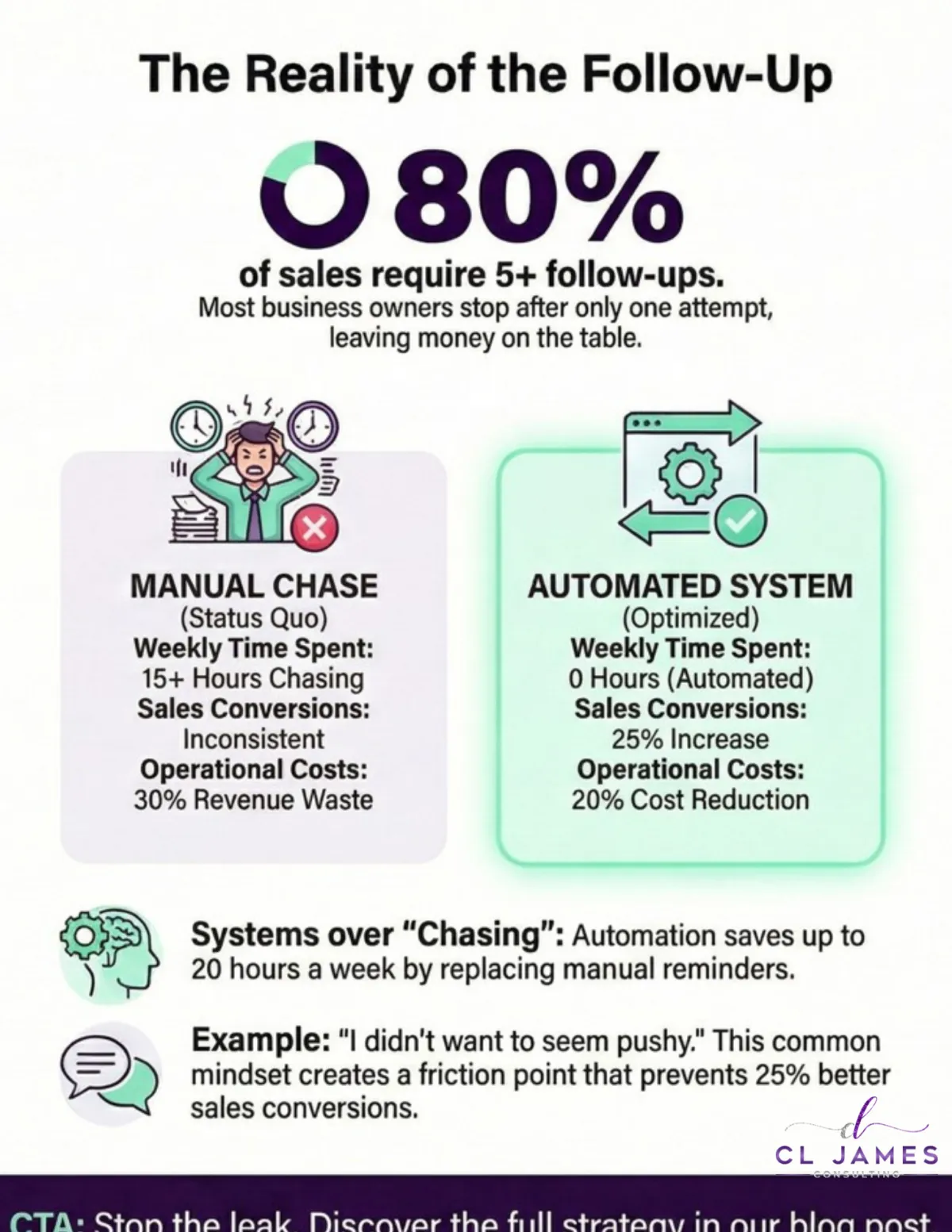
80% of sales require 5 or more follow-ups, yet 44% of salespeople give up after just one attempt. That gap — between what it takes to close and what most business owners actually do — is where your revenue is quietly leaking out.
The "I Don't Want to Seem Pushy" Problem
This is the one nobody wants to admit. You hold back on follow-up because you don't want to bother anyone. You figure if they were interested, they'd reach back out.
That mindset is costing you 25% better sales conversions. Not a soft estimate — actual revenue walking out the door.
Here's the reframe: follow-up isn't pushy. Ghosting your leads is just leaving them with no clear next step. A well-timed, well-worded follow-up is a service. It says: I remember you, I'm still here, and I want to help.
The problem isn't that you're following up too much. It's that you're doing it manually, inconsistently, and running out of bandwidth before you ever hit touchpoint five.
Manual Chasing vs. an Automated Follow-Up System
Let's look at the real cost of keeping things manual.
When you're manually chasing leads, you're spending 15+ hours a week on follow-up tasks — checking inboxes, setting calendar reminders, trying to remember who you contacted last Tuesday. Your sales conversions are inconsistent because some leads get three touchpoints and some get zero, depending on how chaotic your week is. And you're hemorrhaging roughly 30% of potential revenue to deals that slipped through the cracks.
An automated follow-up system flips that entirely. You reclaim those hours. Your follow-up runs on a consistent cadence regardless of how busy you are. Businesses that systematize their follow-up process consistently outperform their competition, regardless of team size.
The difference isn't hustle. It's infrastructure.
What an Automated Follow-Up System Actually Does
A good automated follow-up system isn't a cold, robotic email blast. It's a smart sequence that shows up for your leads the way you would — if you had unlimited time and a perfect memory.
Here's what it handles for you:
Instant acknowledgment. When a prospect fills out a form, they're actively looking for a solution — and they're likely filling out forms for two or three of your competitors simultaneously. An automated response that goes out immediately keeps you in the running before you've even looked at your phone.
Consistent touchpoints. Your system sends the right message at the right interval — day one, day three, day seven — without you lifting a finger. No lead falls through because you got busy.
Behavior-based sequencing. If someone opens your email three times but doesn't respond, that's a signal. A smart system can flag that lead for a personal follow-up at exactly the right moment.
Lead pipeline visibility. You can see at a glance where every prospect is in your process — not a spreadsheet you're guessing at, but a live view of what's moving and what's stalled.
The result? Consistent, automated follow-up can deliver a 25% increase in sales conversions and a 20% reduction in operational costs — because you stop wasting time chasing cold leads manually and start closing the warm ones systematically.
The Real Question to Ask Yourself
Here's your gut-check for this week: if you went on a two-week vacation tomorrow, what happens to the leads that come in while you're gone?
If the answer is "probably nothing good," your pipeline has a leak. And it's been leaking every single week, even when business feels fine. Lost opportunities don't appear in reports — businesses rarely track the leads that never responded after a delayed reply, which creates a false sense of stability. Sales still trickle in, so the broken system feels acceptable. Until you see what you've been leaving behind.
How to Get Started Without Overhauling Everything
You don't need to blow up your whole tech stack to fix this. Start with the three most common leak points:
The no-show. Someone books a call and ghosts. Do you have an automated reminder sequence? If not, that's your first fix.
The slow response. A lead reaches out and you don't respond for hours. Automated acknowledgment fixes this instantly.
The one-and-done. You sent one follow-up email and stopped. Build out a 5-touch sequence and let your system run it.
None of this requires you to be tech-savvy. It requires a clear process and the right setup — which is exactly the kind of work that should be done once and run forever.
Find Out Where YOUR Pipeline Is Leaking
Before you can fix your follow-up, you need to know where the holes are. That looks different for every business — which is why I created the Free Lead Leak Finder, a self-audit tool that helps you identify exactly where leads are slipping out of your pipeline and what to do about it.
It's fast, it's free, and it'll show you in black and white what your follow-up gap is actually costing you.
→ Grab the Free Lead Leak Finder
Stop losing leads to silence. Your system should be working even when you're not.
Frequently Asked Questions
What does "automated follow-up" mean for a small business? Automated follow-up means using software to send timely, pre-written messages to your leads based on specific triggers — like when someone fills out a contact form, books a call, or goes quiet after a proposal. It removes the need for you to manually track and reach out to every prospect.
How many follow-ups should I send before giving up on a lead? Research consistently shows that 80% of sales require at least five follow-ups. Most business owners stop after one or two. A well-built automated sequence typically includes five to seven touchpoints spread over two to four weeks before a lead is marked inactive.
Will automated follow-up feel impersonal to my clients? Not when it's built correctly. Personalization tokens (like first name and service inquiry), conversational language, and behavior-based sequencing make automated messages feel like they came from you — because the strategy and voice did.
What's the fastest way to stop losing leads right now? Start with two quick wins: set up an automated acknowledgment that goes out within 15 minutes of any new inquiry, and build a simple five-email follow-up sequence for leads who go quiet after a proposal. Those two fixes alone will close most of the gap.
Do I need a CRM to automate my follow-up? A CRM makes it significantly easier, but the most important thing is having a system of any kind. Even a basic email automation tool connected to your intake form is a massive improvement over manual follow-up. As your business grows, a proper CRM with pipeline visibility becomes essential.
